
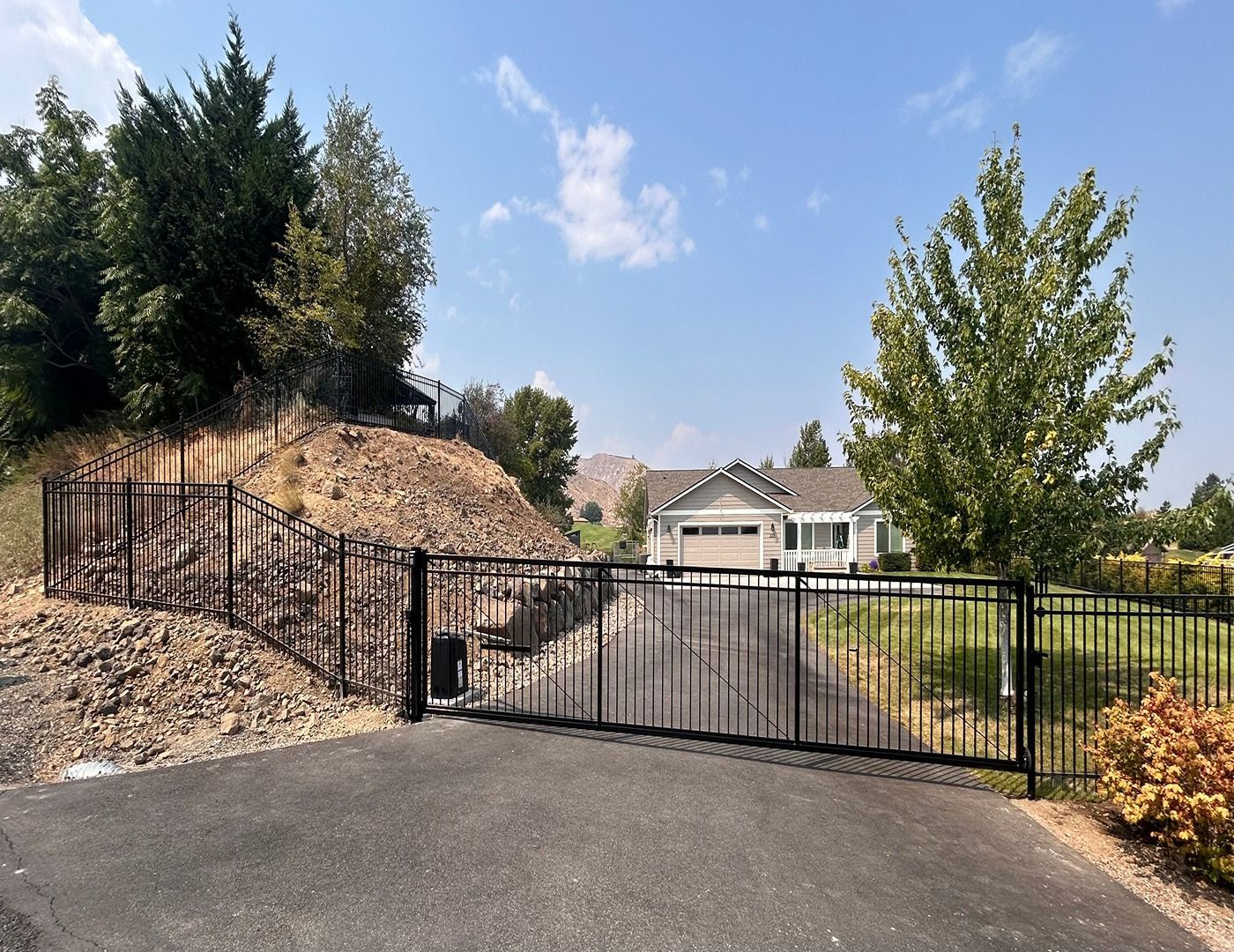
Gates Built to Handle Real Wind Loads
Gate Installation in the Wenatchee Valley for properties where post failure, swing misalignment, or inadequate anchoring creates entry security gaps
Lonestar Fence installs residential and commercial gates in the Wenatchee Valley with a focus on precision alignment and secure post anchoring from the first day of work. Improper post depth is one of the most common reasons gates fail in this region—soil composition and wind pressure combine to shift frames over time, pulling hinges out of plane and making latches inoperable. Property owners dealing with a gate that drags, won't latch, or swings inconsistently under wind pressure are usually dealing with the downstream effects of an installation that didn't account for those local conditions.
Every installation begins with a site assessment to evaluate entry layout, soil conditions, and gate swing direction relative to prevailing wind. Post holes are excavated to code-required depths—shallower footings that might hold in other climates will shift seasonally in the Wenatchee Valley semi-arid soil, particularly in areas with sandy or loamy composition near the Columbia River corridor. After posts are set and concrete has cured, frame assembly follows, with hinge and latch hardware installed and adjusted for smooth operation under load. Final hardware finishing accounts for the gate's weight distribution so the swing doesn't torque the frame.
Request an on-site assessment to review your entry layout and determine the correct post depth and gate configuration for your property.
What Proper Gate Installation Actually Requires
Gate installation involves more than setting posts and attaching a frame—it requires calculating the hinge placement to distribute the gate's weight without creating leverage that bends the frame over time. For wider residential entry gates and heavier commercial access gates, that calculation changes significantly. Lonestar Fence approaches both standard and custom gate installations with the same structural assessment, because a gate that looks level at installation can sag within one season if the hinge mount points aren't positioned relative to the gate's actual center of gravity.
After installation is complete, the gate swings cleanly through its full arc, latches without lifting or forcing, and holds its alignment when wind pushes against the face of the frame. Those are the observable benchmarks that confirm the structural work was done correctly—not just that the gate opens and closes on the day of install, but that it continues to operate correctly as soil moisture changes through the Wenatchee Valley dry summers and wet shoulder seasons.
Installation scope varies between projects—a single residential pedestrian gate and a dual-swing commercial entry gate involve different post counts, frame weights, and hardware grades. Understanding what's included in the installation versus what requires a separate operator or access control system helps set accurate expectations before work begins.
Common Questions About Gate Installation
These questions reflect what property owners in the Wenatchee Valley typically ask before scheduling a gate installation, particularly around post requirements and hardware selection.
What determines how deep gate posts need to be set?
Post depth is calculated based on gate weight, swing width, and soil conditions at the specific install location—in Wenatchee Valley, sandy or shifted soils near the valley floor typically require deeper footings than compacted upland sites to prevent post lean under lateral wind load.
How does wind affect gate swing and hardware selection?
Consistent wind pressure against a gate face creates torque on hinge hardware over time, which is why heavier-gauge hinges and braced frames are standard practice for exposed installations in this region rather than a premium upgrade.
What is the difference between a residential entry gate and a commercial access gate?
Commercial access gates are typically built to higher load ratings, use heavier frame stock, and are designed to integrate with operator or access control systems, while residential entry gates are sized and weighted for pedestrian or single-vehicle use.
When should I schedule gate installation relative to other fence work?
Installing the gate as part of a complete fence project allows post spacing and frame dimensions to be coordinated from the start, which produces better alignment than retrofitting a gate into an existing fence line.
How do I know if a custom gate design will hold up structurally?
Frame geometry, total panel weight, and hinge count all factor into long-term performance—a custom design should be evaluated for those variables before fabrication, not adjusted after the gate is already hung.
Lonestar Fence handles both standard and custom gate installations across the Wenatchee Valley and the surrounding Wenatchee valley. To move forward, schedule a site visit so post requirements, frame dimensions, and hardware selection can be confirmed based on your specific entry layout—contact Lonestar Fence at (509) 906-4484 to arrange that evaluation.