
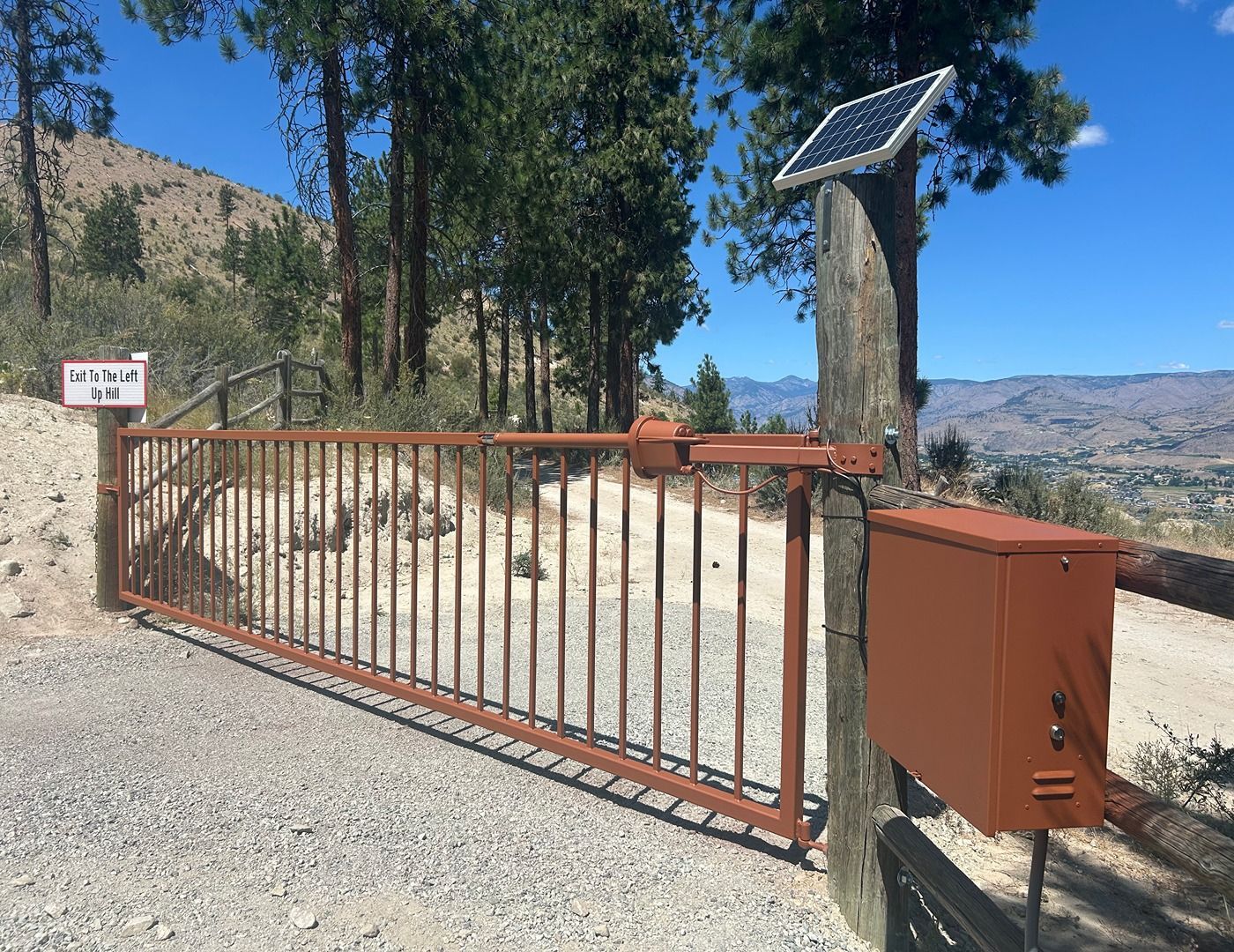
Entry Systems That Manage Who Gets Through
Access Control and Safety Equipment in the Wenatchee Valley for commercial properties and residential ranches requiring managed, verifiable entry point authorization
Electronic access control moves beyond basic gate operation into documented, selective entry management—a meaningful distinction for commercial properties that need to restrict access by credential type or time window, and for residential properties where shared gate codes create audit and security gaps. Lonestar Fence designs and installs electronic access control systems for Wenatchee Valley properties ranging from single-entry residential gates to multi-point commercial facilities. Semi-arid climate conditions and the varied property layouts across Douglas County—including river-adjacent parcels, orchard operations, and commercial sites—affect both the equipment selection and the wiring approach for each installation.
Site assessment identifies the entry points to be controlled and evaluates physical conditions that affect equipment placement: conduit routing paths, surface types, proximity to irrigation or water sources, and exposure to direct sun that affects keypad and card reader longevity. Access device selection follows based on the required credential type—keypads work for fixed codes with limited user management, while card readers and proximity sensors support individual credential assignment that can be revoked without changing a shared code. Wiring and network integration connects the control devices to the gate operator and, where applicable, to building management or monitoring systems. Final system programming and testing confirms that each credential triggers the correct gate response and that unauthorized entries are rejected consistently.
Request a site assessment to map your entry points and identify which access device types match your authorization and audit requirements.
What Access Control Actually Accomplishes
A keypad with a shared code provides basic convenience but no meaningful access management—anyone who knows the code can enter, and changing it requires notifying all authorized users simultaneously. Card readers and proximity fobs solve that problem by assigning individual credentials that can be added or removed from the system without affecting other users. Lonestar Fence selects access devices based on how many people need entry, how frequently credentials need to change, and whether the property requires any record of entry events—not simply on which device is most common for the gate size.
After the system is installed and programmed, each authorized user can trigger gate operation with their assigned credential while unauthorized attempts are logged or rejected at the control board. The visible change is straightforward: gate access is tied to specific credentials rather than a shared mechanism, and revoking access for one person doesn't require a system-wide reset. For commercial properties where contractor access, vendor deliveries, and employee entry all need separate management, that credential structure is what makes the system functional rather than decorative.
Access control installations pair directly with automatic gate openers—the control system signals the opener rather than operating independently. Properties that don't yet have an automated gate operator need that component addressed either before or concurrent with access control installation. Safety equipment such as vehicle loop detectors and photo-eye obstruction sensors can be added to prevent gate closure on vehicles or people in the gate path, which is a standard addition for commercial entries with high daily cycle counts.
Questions Before Starting Your Access Control Project
Property owners in the Wenatchee Valley considering access control installations often have questions about credential types, integration with existing gate hardware, and what the system actually requires to function reliably outdoors.
What is the difference between a keypad system and a card reader system?
Keypads use a shared numeric code that anyone can pass along, while card reader systems assign individual credentials to each user—card readers are the appropriate choice when you need to revoke a single user's access without changing entry credentials for everyone else.
How does outdoor exposure in the Wenatchee Valley affect access control equipment?
Direct sun exposure degrades keypad displays and card reader electronics faster than shaded installations, and dust infiltration from the semi-arid climate is a long-term reliability factor—equipment rated for outdoor use with sealed housings performs significantly better in this environment than general-purpose devices.
Does access control require an internet connection to function?
Basic keypad and card reader systems store credentials locally on the control board and operate without network connectivity—cloud-connected systems that allow remote credential management do require network integration, which affects both installation scope and ongoing requirements.
What safety equipment is typically added alongside access control?
Vehicle loop detectors embedded in the driveway surface detect when a vehicle is in the gate path and prevent closure, while photo-eye sensors provide the same protection for pedestrians—both are standard safety additions for commercial gates with frequent daily use cycles.
How many entry points can a single access control system manage?
System capacity depends on the control board selected—single-entry residential systems are sized differently from multi-point commercial controllers, and that determination is made during the site assessment based on your actual entry point count and credential volume.
Lonestar Fence installs access control and safety equipment for residential and commercial properties across Wenatchee Valley, and Douglas County. To discuss your entry points and credential requirements in detail, call (509) 906-4484 and set up a consultation with the Lonestar Fence team.